
Sold
Large 18th Century Grand Tour Etching
This piece has found a home. We regularly acquire comparable objects — tell us what you are looking for, or see the pieces below.






About this object
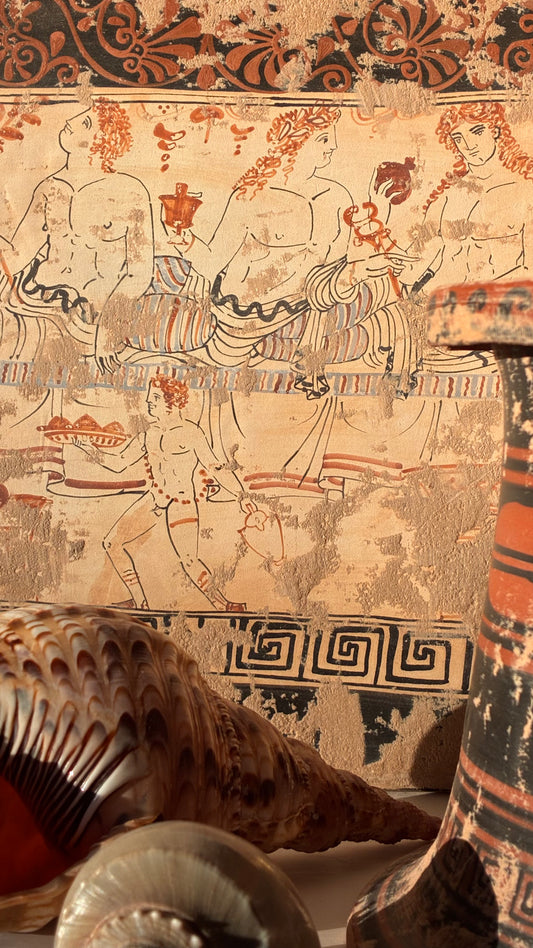
An exquisite and rare etching of an ancient fresco from the 'Domus Aurea', Nero's sumptuous imperial complex in Rome, from 'Vestigia delle terme di Tito e loro interne pitture' by Marco Carloni (Italian,1742-1796) after Franciszek Smugliewicz (Polish, 1745-1807), published by Ludovico Mirri in Rome, circa 1776–78.
Why we like it
Exquisitely engraved in the 18th century, the print perfectly represents the essence of the Grand Tour, the artist's appetite for discovery, for the unexplored, for the exotic.
Original copper-plate engraving, signed in the bottom Franc. Smugliewicz Pit. Polacco disegno, Presso Ludovico Mirri Mercante de' Quadri Incontro al Palazzo Bernini a Roma, Marco Carloni Romano incise.
History
Situated between the Palatine and Esquiline Hills in Rome and designed by architects Severus and Celer, the Domus Aurea (Golden House) was erected by Nero in 64 AD after the great fire in Rome. The magnitude and decadent extravagance of the impressive gold-covered, jewel bedecked palace was intended to glorify the Emperor's reign. Its rooms were filled with lavish furniture and its walls and ceilings covered with decorative late-Hellenistic murals by the renowned ancient artist Fabullus. Nero, however, died in 68 AD before the Domus was totally completed. Years later, Titus (and later Trajan) built his thermal bath over its ruins, which were used as a foundation for and were partially preserved by Titus' edifice. Successive emperors continued to erect various buildings on the site and subsequently make several renovations to the Domus substructure. In 1480, practically forgotten, the Domus was excavated, and its subterranean passages and rooms thereafter became known as 'le grotte' (cave). Many of its original frescoes survived, and their motifs and ancient style of ornamentation, called 'grotteschi' (grotesque) after 'grotte', became extremely popular during the Renaissance, influencing many prominent artists such as Raphael, Michelangelo, Ghirlandio, and Pinturicchio. Published in the late eighteenth century, 'Vestigia delle terme di Tito e loro interne pitture' is an elaborate album of engravings depicting the stunning 'al fresco' and 'al stucco' murals of Nero's Domus Aurea. Carloni's colourful and beautifully rendered plates faithfully capture the grotesque style of the ancient frescoes, which was characterized by decorative borders filled with whimsical, often comical animals and foliage taken from both nature and the artist's imagination. The ornamental borders also served the practical functions of framing the central mythological, religious, or historical subject portrayed and separating the various murals in a single decorative scheme.
Franciszek Smugliewicz (1745 – 1807) was a Polish-Lithuanian draughtsman and painter. Born in Warsaw to an artistic family, he was trained in his father's workshop in Warsaw. In 1763 Franciszek journeyed to Rome to study fine arts under the tutorship of Anton von Maron. He stayed in Rome for 21 years, where as a colleague of Vincenzo Brenna he participated in cataloging artifacts from Nero's Domus Aurea.
Plate measures 52 cm by 48 cm (20.5 in by 19 in), frame 74 cm by 71 cm (29 in by 28 in)
Good antique condition, minor foxing, later colouring.
Not quite it?
Tell us what you are hunting for
We buy every week, and much of what we find never reaches the site. Describe the piece and we will write when it turns up.