
Sold
Regency Parcel Gilt and Brass Inlaid Dining Table
This piece has found a home. We regularly acquire comparable objects — tell us what you are looking for, or see the pieces below.






About this object
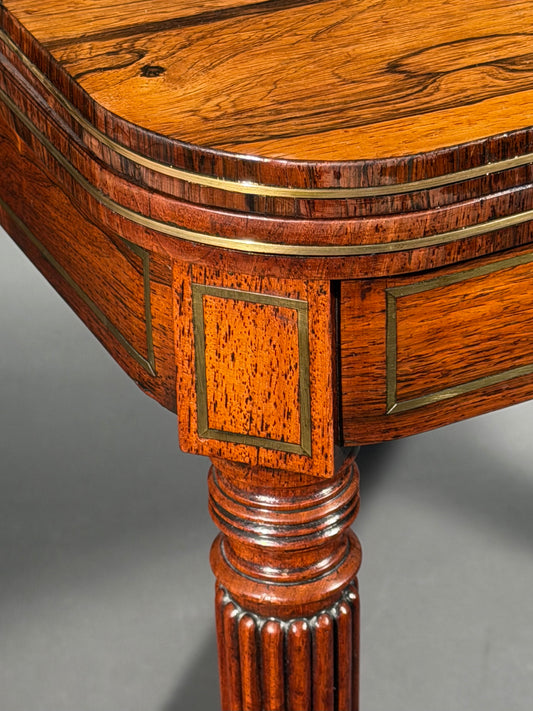
An imposing Regency period circular table for six, in rosewood, decorated with brass line inlays and gilding.
England, circa 1810–20.
Why we like it
Designed in the distinctive 'Roman' style, that replaced the sober and understated Grecian taste of the late Georgian era and symbolised power and grandeur, this bold and imposing table certainly makes a statement in a room.
This bold model reflects the designs of Royal architect/designer Henry Holland and the furniture supplied under his direction to Samuel Whitbread II for Southill Park, Bedfordshire beginning in 1796. English cabinet-makers whose names appear most frequently in conjunction with Holland include Morel, Marsh, Lichfield and Tatham (F. J. B. Watson, Southill: A Regency House, 1951, p. 23)
The monumental base resting on four gilded volute-shaped feet supports a column shaped as fascis lictoriae - a symbol of power and authority (imperium) in ancient Rome, widely incorporated within the governmental iconography in the early 19th century architectural design. Use of the fasces in Rome was surrounded with tradition and protocol. A corps of lictors each carried fasces before a magistrate, in a number corresponding to his rank. Lictors preceded consuls (and proconsuls), praetors (and propraetors), dictators, curule aediles, quaestors, and etc. The highest magistrate, the dictator, was entitled to twenty-four lictors and fasces, the consul to twelve. The symbolism of the fasces suggests strength through unity; a single rod is easily broken, while the bundle is very difficult to break.
Many institutions in different countries, particularly those who see themselves as modern-day successors to the old republic or its ideals, have incorporated representations of the fasces into their iconography. In the United States for example, in the Oval Office, the fasces are depicted above the door leading to the exterior walkway, and above the corresponding door on the opposite wall, which leads to the president's private office.
Not quite it?
Tell us what you are hunting for
We buy every week, and much of what we find never reaches the site. Describe the piece and we will write when it turns up.