
Sold
Early 19th Century Engraving Belisaire by Desnoyers, 1806
This piece has found a home. We regularly acquire comparable objects — tell us what you are looking for, or see the pieces below.
-
-
-
Nuremberg (Johann Christoph Weigel), Published 1680–1726
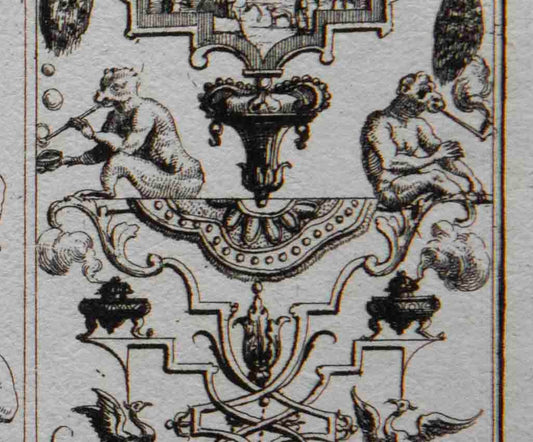
Four 17th Century German Engravings of Grotesques
-
-
-






About this object
Early 19th century engraving, titled Bélisaire, after Baron François Pascal Simon Gérard's (1770 – 1837) painting Belisarius, 1797 [Getty Museum, object number 2005.10]. Engraved by Auguste Gaspard Louis Desnoyers, France, 1806.
Why we like it
We admire the story behind the artwork which offers several lessons about human condition. Here is the story as retold by the curators at the Getty: "Along a winding dirt path, the blind Belisarius carries his young guide. The boy has been bitten by a snake, which remains coiled around his bleeding leg. With his right arm wrapped limply around Belisarius's neck and his eyes closed, the youth balances precariously between life and death. Belisarius's eyes are also closed, but guided by his stick he moves forward with determination and purpose. He rises heroically against the spectacular sunset, a monumental figure creating a powerful outline against the sky. But the flaring sunset also signals a chill night and the uncertainty of the path ahead. Belisarius was a popular Byzantine general of the Roman Empire whose promising career was sabotaged by the jealous Emperor Justinian I. In 1767, a novel by Jean-François Marmontel revived interest in Belisarius. In Marmontel's novel, the emperor has the heroic general blinded, reducing Belisarius to begging. He is eventually rediscovered and aided by former officers and his family. This dramatic tale of patriotism, injustice, and redemption was widely embraced in revolutionary and post-revolutionary France and was a popular subject for artists--including Jacques-Louis David (François Gérard's teacher), Jean-Antoine Houdon, and Jean-Baptiste Stouf (whose sculpture Belisarius is also in the Museum's collection). For this painting, Gérard both drew and departed from Marmontel's retelling of Belisarius's life. The general's young companion is present in Marmontel's novel. But to stress the bravery and pathos of the subject, Gérard introduced the incapacitating snakebite. While Belisarius was typically depicted in the act of begging, Gérard shows him standing and erect, his muscular form in sharp contrast to his guide's weakening body. The prominent helmet hanging from Belisarius's belt emphasizes the general's heroic past and underscores the injustice of his fall from favor." This engraving would be an exceptional addition to any collection for its blend of historical narrative and artistic craftsmanship. It holds the rare ability to be both elegant and thought-provoking—a true testament to the art and philosophy of its time.
Dimensions
Size of the engraving: 54 cm x 38 cm / 21.25" x 15"
Size of the frame: 72.5 cm x 53 cm / 28.5" x 21"
Not quite it?
Tell us what you are hunting for
We buy every week, and much of what we find never reaches the site. Describe the piece and we will write when it turns up.