
Sold
19th Century Chinese Export Lacquer Mirror
This piece has found a home. We regularly acquire comparable objects — tell us what you are looking for, or see the pieces below.
-
-
China (panel), Late 17th century panel; converted circa 1920s–1940s
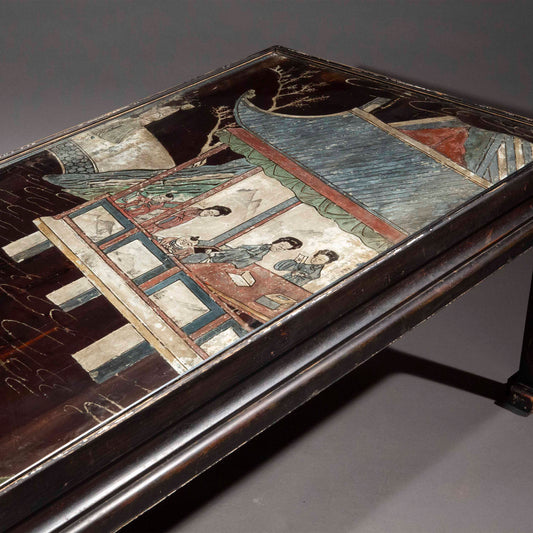
17th Century Chinese Lacquer Panel Coffee Table
-
Canton, China, Qing dynasty, circa 1830–50; frame late 19th century
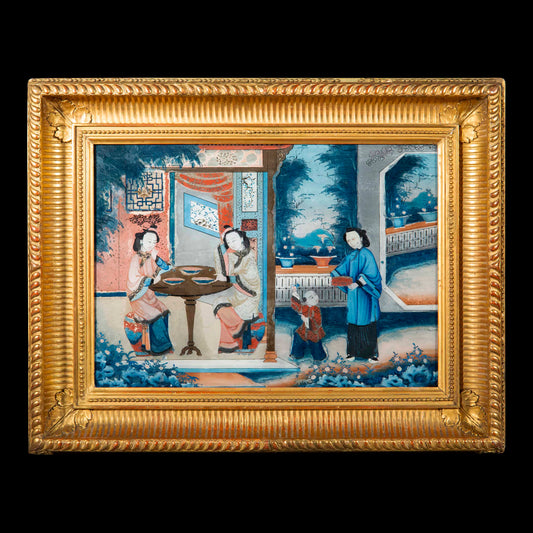
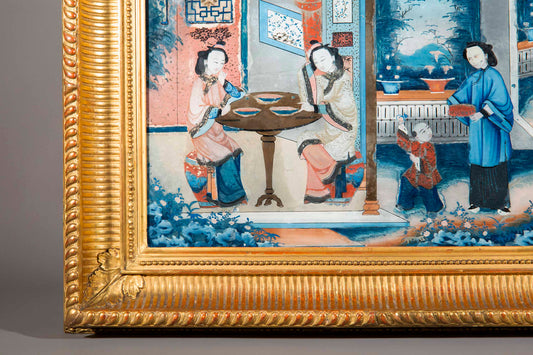
19th Century Chinoiserie Reverse Glass Painting
-




About this object
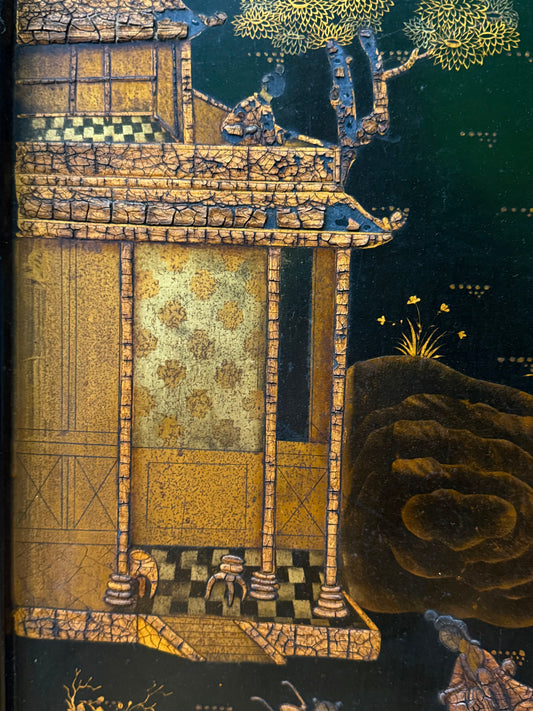
A rare and decorative Chinese export dressing mirror in black lacquer, exquisitely gilt-decorated with its original mercury plate, reverse-painted with exotic birds. It retains its original handles and the trade label of Town and Emanuel, who retailed it in the 1830s.
Qing dynasty, early 19th century.
Why we like it:
This is a rare and beautiful piece, featuring a reverse-painted mirror plate. Such luxurious items were popular in England during the height of the chinoiserie trend.
Provenance:
Christie's, New York, 22 April 1989, lot 17.
Illustrated:
Christopher Gilbert, Pictorial Dictionary of Marked London Furniture 1700-1840, London, 1996, p. 453.
A similar example from The Metropolitan Museum of Art is illustrated in Carl Crossman, The Decorative Arts of the China Trade, 1991, p. 286.
Town & Emanuel:
In about 1830, Charles Town and Emanuel Emanuel established Town & Emanuel at 103 New Bond Street. By 1840, they were dealers and importers of antique furniture, curiosities, and pictures. By 1842, they were known for manufacturing ‘buhl, marqueterie, resner & carved furniture.’
A circular occasional table with a porcelain bowl inset, from the Duke of Buccleuch's collection, was noted in the V&A archives as sold by Christie's in 1948. The label on this table describes the firm as manufacturers of Buhl Marquetrie, Resner & Carved Furniture, and other luxury items, by appointment to Her Majesty.
A Buhl monopodium games table, acquired by Queen Mary around 1930, also bears their label (illus. Collard, Furniture History (1996), p. 84), as does a small kingwood and tulipwood ‘bureau plat’ of Louis XV style, with serpentine top and ormolu handles.
In 1830, Town & Emanuel provided the 3rd Lord Braybrooke with a looking-glass costing £8 5s for Audley End or his London house.
In 1838, they supplied 'new furniture' for Stafford House, London, at £12 12s. By 1839-40, they were listed as Town & Co., 'dealers in & Manufacturers of antique furniture, curiosities, & pictures.'
Francis Gibson of Saffron Walden visited the shop in 1835 and 1836, noting the 'magnificent furniture.'
The 1849 sale catalog included objects from Wanstead (1822), Fonthill (1823), and Stowe (1848), as well as Italian furniture from Doge Manin’s Palace, brought to England by Milanese dealer Gasparoni, and sold by Town & Emanuel c.1835 to clients like the Duke of Buckingham. Sir Andrew Fontaine acquired four armchairs from the Doge’s palace, now in Manchester City Art Gallery. Town & Emanuel reportedly made £6000 on the sale of Gasparoni’s collection.
The 2nd Marquess of Exeter purchased 12 Walnut High Backed chairs and 2 stools for Burghley in 1836 from the Doge’s Palace (illus. Collard, Furniture History (1996), p. 83).
In 1839, William Bankes bought a Venetian ceiling for Kingston Lacey at £100. The firm also provided him with measurements and prices for Venetian leather, though he did not purchase them.
The 1849 catalog included a "beautiful coffer, of buhl and tortoiseshell, with ormolu ornaments," possibly similar to a pair of buhl tables acquired by the 5th Duke of Buccleuch.
A writing table at Burghley (illus. Collard, Furniture History (1996), p. 85) is attributed to Town & Emanuel, who replicated Louis XV furniture, such as a kingwood writing table bought for the Blue Drawing Room at Burghley for £21 in 1836 (illus. Collard, Furniture History (1996), p. 86).
The 1849 catalog also listed a "Cabinet Pianoforte in a case of satinwood, with borders of kingwood and Sevres plaques" (lot 583), the State Bed from Stowe (lot 542), and an oval looking-glass with a richly carved frame probably by W.G. Rogers.
After the 1849 stock sale, Josiah Thoms, previously an assistant at Town & Emanuel, and William Luscombe took over the New Bond Street premises and established Toms & Luscombe. Additional examples of the firm’s furniture are illustrated in Gilbert (1996), figs 902-915.
Sources: BIFMA; DEFM; Collard, ‘Town & Emanuel’, Furniture History (1996); Gilbert, Pictorial Dictionary of Marked London Furniture 1700-1840 (1996).
Presented in very good antique condition, retaining its original brassware and decoration.
Not quite it?
Tell us what you are hunting for
We buy every week, and much of what we find never reaches the site. Describe the piece and we will write when it turns up.