


England, Late 19th century
Neoclassical Satinwood Corner Cabinet with Siena Marble Top
Mainland UK delivery: Free
Couldn't load pickup availability
| Period | Late 19th century |
|---|---|
| Origin | England |
| Material | Satinwood, kingwood and tulipwood marquetry; Siena marble top; gilt-bronze mounts |
| Dimensions | H 84 × W 92 × D 65 cm H 33 × W 36.25 × D 25.5 in |
| Condition | Ready for placement and immediate use. |
| Provenance | Sotheby's London, Important English Furniture, 23 November 2005, lot 63, one of a pair. |
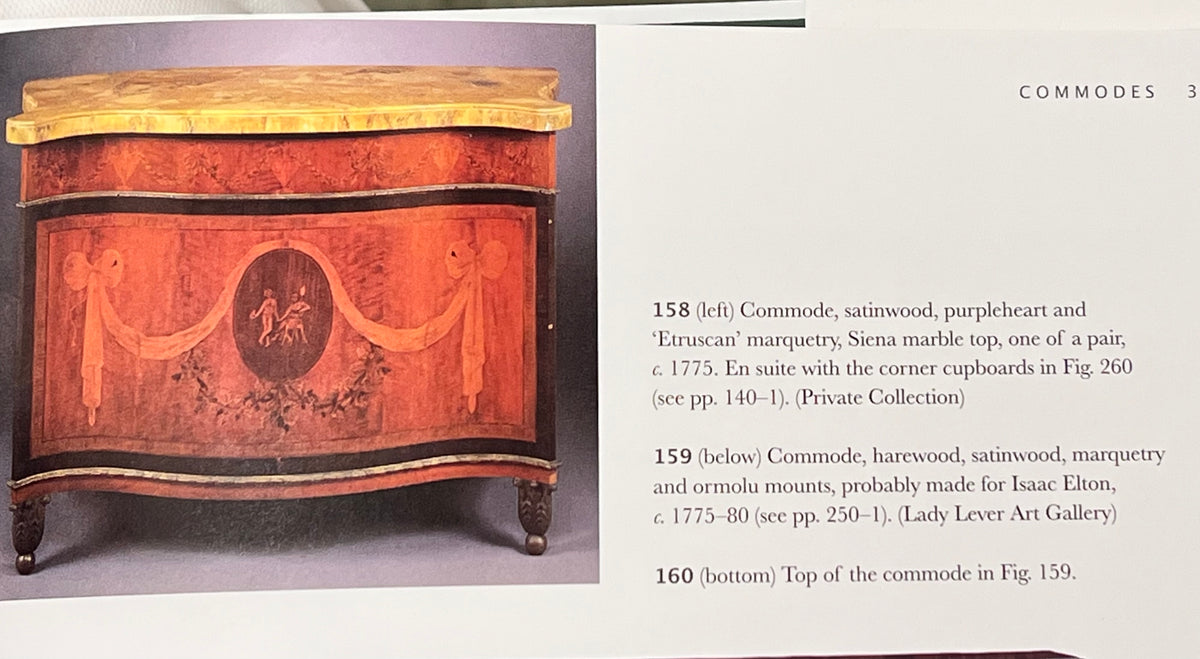
A fine serpentine corner cabinet in satinwood, kingwood and tulipwood marquetry, the shaped Siena marble top above a frieze inlaid with urns, garlands and ribbons, the door centred by an oval medallion of two classical figures after a vase in the collection of Sir William Hamilton, flanked by swags of drapery with tasselled cords and above a garland of oak leaves and acorns, the whole with gilt-bronze mouldings and raised on acanthus-cast gilt-bronze feet.
In the manner of Mayhew & Ince.
England, late 19th century.
Why we like it
We have a great weakness for English Neo-Classicism and its polite, graceful language. This corner cabinet has everything we look for: an elegant serpentine form, beautifully figured satinwood, refined marquetry in the Adam taste and a superb Siena marble top.
At its heart is a medallion taken from Sir William Hamilton's celebrated collection of ancient vases, bringing the spirit of the Grand Tour into an English interior.
Corner pieces of such elegance and refinement are extremely rare. This one has the quality and presence of a fine commode, made to grace the corner of a drawing room. Rare, beautifully proportioned and full of charm.
The Medallion
The medallion reproduces the scene on an Attic lekythos from the first collection of Sir William Hamilton (1730–1803), British envoy at Naples. It shows a bearded Dionysus seated with his thyrsus and Pan holding a komast cup.
The vase was published by Pierre-François Hugues d'Hancarville in Collection of Etruscan, Greek and Roman Antiquities from the Cabinet of the Honble. Wm. Hamilton, vol. I, pl. 104. Hamilton and d'Hancarville meant these engravings partly to serve as models for contemporary designers. The vase is now in the British Museum (GR 1772,3-20.301; BM Vases F 114), which bought Hamilton's first collection of vases in 1772.
Mayhew & Ince
John Mayhew (1736–1811) and William Ince (d. 1804) ran one of the most successful and longest-lived cabinet-making partnerships of the 18th century. First recorded as partners in December 1758, they were advertising from Broad Street by the following January. In 1762 they published The Universal System of Household Furniture, dedicated to the 4th Duke of Marlborough. It was a pattern book in the Rococo taste, and it appeared just as fashion was turning towards the Neo-Classicism of Robert Adam. The firm moved with the times, making furniture to Adam's own designs for a number of his clients. By the 1780s it was concentrating on cabinet-making and upholstery as veneered and inlaid furniture came into fashion. Its patrons included the Prince of Wales, the 5th Duke of Devonshire, the 5th Duke of Bedford, and the 1st Duke and Duchess of Northumberland.
Provenance
Sotheby's London, Important English Furniture, 23 November 2005, lot 63, one of a pair.
Related Examples
The cupboard follows a suite of "Etruscan" marquetry furniture attributed to Mayhew & Ince, of about 1775: a pair of corner cupboards with Siena marble tops, now at Spencer House, London, and a commode en suite, one of a pair, also with a Siena marble top, in a private collection. The commode is centred by the same medallion of Dionysus and Pan as the present cupboard. The Spencer House cupboards bear both medallions found on the present pair, Dionysus with Pan and two draped figures beside an altar.
A second pair of corner cupboards with the same two medallions, of about 1773 and probably made for Archibald Douglas, is at Rienzi, the Museum of Fine Arts, Houston, given by Mr and Mrs Harris Masterson III.
See Hugh Roberts and Charles Cator, Industry and Ingenuity: The Partnership of William Ince and John Mayhew, figs. 158, 259 and 260.
Dimensions
Height: 33 in / 84 cm
Width: 36.25 in / 92 cm
Depth: 25.5 in / 65 cm
Condition
Ready for placement and immediate use.




Not quite it?
Tell us what you are hunting for
We buy every week, and much of what we find never reaches the site. Describe the piece and we will write when it turns up.