


Oleograph after Agnolo Bronzino's Portrait of a Young Man at The Met
Couldn't load pickup availability
Three Fixed Delivery Rates
Free delivery over £10,000

LAPADA
-
Longtime Member

CINOA


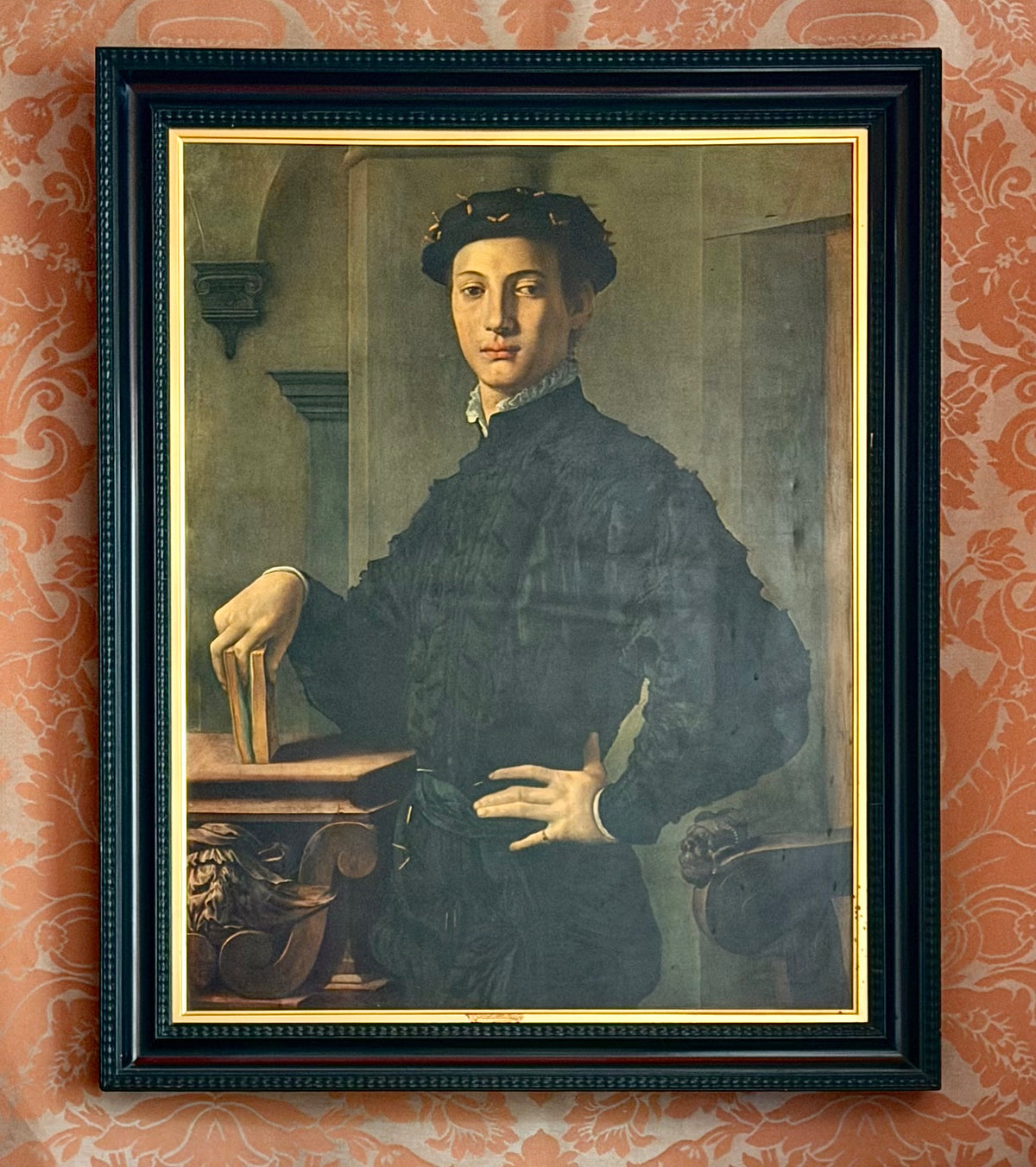
An oleograph after Agnolo Bronzino's Portrait of a Young Man at the Metropolitan Museum of Art, New York.
An oleograph is a chromolithograph printed on cloth or canvas and then varnished so that it looks like an oil painting. That technique gives this piece its canvas texture and surface sheen.
Presented in an ebonised wooden frame with several bands of ripple-pattern moulding, in the style of 17th-century Dutch frames.
Mid-20th century.
Why we like it
He's arrogant and he knows he's beautiful, and that's what got us. Bronzino painted him nearly five hundred years ago and he's still the coolest man in any room. You can't stop looking at him.
Historical and Artistic Context
The original painting is one of the Met's best-known Italian Renaissance portraits. It is painted in oil on wood, measures 95.6 x 74.9 cm (37 5/8 x 29 1/2 in.), and came to the museum in 1929 through the H. O. Havemeyer Collection, a bequest of Mrs. H. O. Havemeyer. The Met dates it to the 1530s and hangs it in Gallery 612. The proportions of this reproduction match the original panel, so it shows the full composition without cropping.
The sitter is a young man in black. He wears a dark beret trimmed with gold aglets and a small white ruff at the collar, and he stands against a grey-green architectural interior. His right hand holds a book with his fingers between its pages; his left hand rests on his hip. The museum says his identity is unknown, but that he must have belonged to Bronzino's close circle of literary friends in Florence and is probably holding a book of poetry. Bronzino was himself a poet. The Met's curators also point to the painting's hidden wit. Bronzino drew on the ancient Roman decorative tradition of grotesques for the carved heads on the table and chair, and suggested a mask-like face, almost hidden, in the folds of the young man's breeches. These monstrous faces set off his good looks and may imply that his carefully constructed appearance is itself a kind of mask.
Dimensions
Framed: 31” x 38” / 79cm x 96.5cm
Canvas: 28.75” x 35.5” / 73cm x 90cm
Condition
Gorgeous as is and ready for placement. There is a restored tear to the canvas, however, it does not distract from the overall appearance. Minor losses to frame.