
Sold
Powderham Castle: A Regency Klismos Stool
This piece has found a home. We regularly acquire comparable objects — tell us what you are looking for, or see the pieces below.






About this object
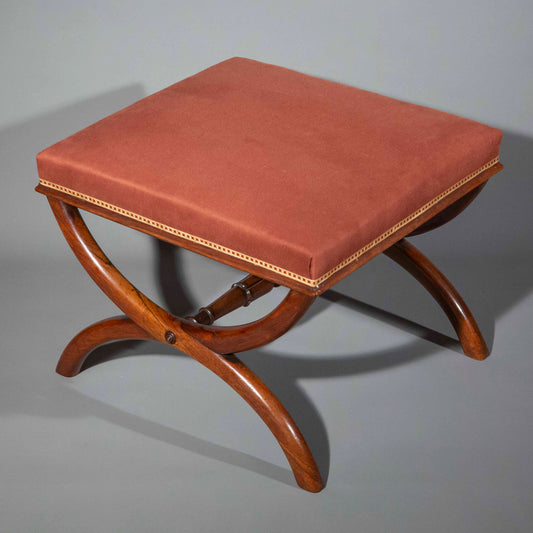
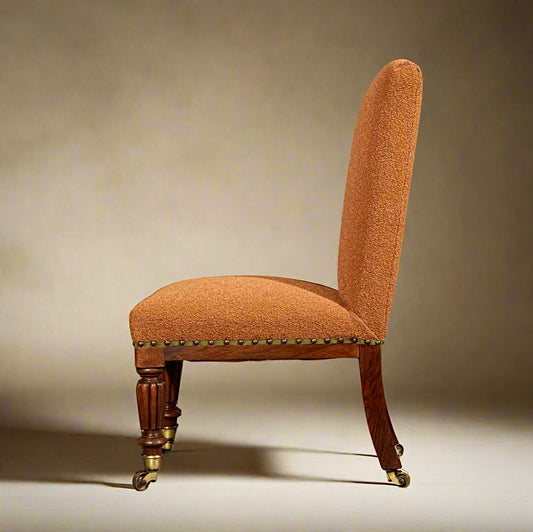
An extremely rare, late George III – early Regency era giltwood music stool of Klismos’ form, in the Grecian style of Henry Holland, originally supplied to Powderham Castle, Devon. English, circa 1790–1810
Why we like it
We love its extremely elegant and unusual ‘Klismos’ design, while the Courtenay and Beckford connection add a titillating personal flair to this object, beautiful in its own right.
Provenance
William ‘Kitty’ Courtenay, 3rd Viscount Courtenay, later 9th Earl of Devon of Powderham Castle, near Exeter, Devon.
The 3rd Viscount William 'Kitty' Courtenay-later 9th Earl of Devon - left the most indelible mark on Powderham, commissioning some of the Castle's most exquisite interiors. Chief among these is the Music Room, designed by James Wyatt and executed by the sculptor Richard Westmacott in the early 1790s. Given the characteristic form of this stool, it is not inconceivable to assume that it was likely commissioned for the Music Room. The largest room in the Castle, it was designed as a setting for performance and display, offering a stage for the Earl's cultivated world.
Known for his beauty and his acute artistic sensibility, Courtenay was a notable figure in Regency society, being a close friend and a muse for another celebrity of the day, William Beckford, the Gothic writer, gentleman architect, and fellow aesthete.
Design
The distinctive form of this music stool reflects the designs of Royal architect/designer Henry Holland and the furniture supplied under his direction to Samuel Whitbread II for Southill Park, Bedfordshire beginning in 1796. English cabinet-makers whose names appear most frequently in conjunction with Holland include Morel, Marsh, Lichfield and Tatham (F. J. B. Watson, Southill: A Regency House, 1951, p. 23).
The distinctive form of the curved legs is inspired by ancient Greek 'Klismos' chairs, often depicted on Attic pottery starting from circa 400BC.
Dimensions
Height: 18.25 in / 46.5 cm
Diameter: 17.5 in / 44.5 cm
Condition
Original, unrestored country house condition, presenting its original upholstery under the Italian linen/cotton slipcover. Sturdy and ready for immediate placement and use. professional reupholstery may be undertaken at buyer’s request.
Not quite it?
Tell us what you are hunting for
We buy every week, and much of what we find never reaches the site. Describe the piece and we will write when it turns up.