


19th Century Chinese Lacquer Screen
Couldn't load pickup availability
Three Fixed Delivery Rates
Free delivery over £10,000

LAPADA
-
Longtime Member

CINOA


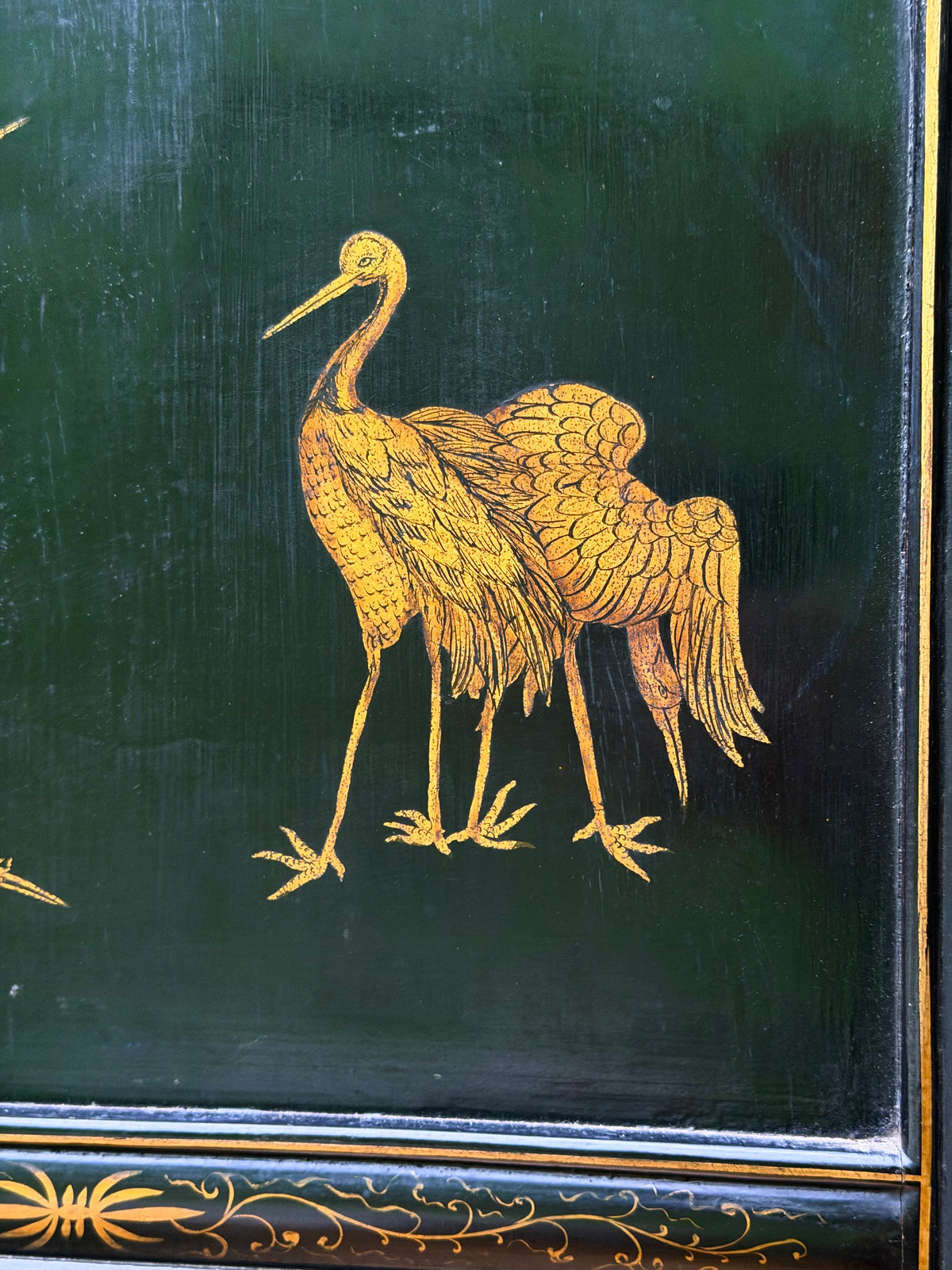
A very fine four-panel black japanned screen in the Chinese taste, decorated in gilt on both sides.
The front shows river landscapes in raised and flat gilding, with pavilions, a pagoda, walled courtyards and figures going about their day. Above them, shaped panels show birds among blossom, reeds and gnarled branches.
On the reverse, the flowering trees, bamboo and peonies grow from pierced scholar's rocks, with cranes, birds, butterflies and dragonflies in the panels above are on full display. Each leaf has an arched top and a key-fret apron, and gilt borders run down the stiles.
England, 19th century.
Why we like it
We love that much of that imagery carries meaning. The crane stands for longevity. The peony is the flower of wealth and honour. Bamboo, which bends but does not break, represents integrity. Scholar's rocks were prized by the educated elite as miniature mountains for contemplation.
Historical and Artistic Context
Lacquerware from China and Japan reached Europe in growing quantities during the 17th century and quickly became a luxury few could afford. European craftsmen answered the demand with japanning, an imitation of Asian lacquer made with layers of varnish over a painted or gessoed ground. Raised decoration was modelled in gesso and finished with gold leaf or metal powders. In 1688 John Stalker and George Parker published A Treatise of Japaning and Varnishing, which supplied both techniques and patterns, and the craft flourished in England for the next century.
Chinoiserie had never quite gone out of fashion. It returned with new force in the late 19th and early 20th centuries, when japanned screens, cabinets and occasional furniture became a fixture of the fashionable drawing room. Like the best of them, this screen does not set out to copy China faithfully. It offers an imagined East of pagodas, pavilions and flowering gardens, and that is its charm.
Dimensions
Height: 69 in / 175 cm
Width: 59 in / 150 cm
Each Panel: 19.3 in / 49 cm
Condition
Signs of age, wear and losses throughout, occasional rubbing, chipping and touchups to decoration.